
Women’s work – women’s everyday lives – women’s rights
New exhibition at the Teachers' house from 13 September

Petra Flemming: Women, panel painting, 1973–1974, Flemming estate, C. Flemming (CC-Sa 3.0)
From 13 September 2026, Open Monuments Day, the association baudenkmal bundesschule bernau will be hosting the exhibition ‘Women’s Work – Women’s Everyday Life – Women’s Rights’ by the German Trade Union Confederation (DGB) at its premises in the Teachers' house at Hannes-Meyer-Campus 9 in Bernau-Waldfrieden.
The exhibition will thus be on display at a venue whose own history is closely linked to the trade union movement: For over four decades, trade union work was carried out here and trade unionists were trained – initially at the FDGB’s ‘Theodor Leipart’ Trade Union School (1947–1951), and subsequently at the ‘Fritz Heckert’ Trade Union College (1952–1989). The exhibition thus forges a direct link between the site’s historical use and questions concerning women’s work, everyday life and rights won through trade union struggle – issues that remain relevant to this day.
The exhibition ‘Women’s Work – Women’s Everyday Life – Women’s Rights’ explores the situation and experiences of working women in the GDR, after reunification and today. Using the example of women from various sectors, the exhibition highlights three ‘eras’, their respective contexts, and the historical and social changes that have taken place.
The exhibition aims to stimulate the exchange of experiences and invites dialogue between the generations. It seeks to encourage people to campaign for decent work and equality, for democracy and human rights – and not just on 8 March!
Women from Brandenburg are the faces of this exhibition. They are active trade unionists and have served or currently serve on works councils. We have supplemented their accounts of 60 years of living and working in Brandenburg with historical material and images from everyday life.
The exhibition pays tribute to all the women who, amidst changing political, economic and social conditions, have stood their ground to this day. They are the ones who campaign for the preservation of jobs, better working conditions and family-friendly working hours – and who are still fighting for equal pay for equal work.
A look at women’s work, everyday life and women’s rights in Brandenburg necessarily includes a retrospective on living and working conditions during the GDR era. Remembering poses a challenge: ‘That’s how it was!’ ‘Was it really like that?’ The exhibition documents very personal answers.
Being curious, learning, taking one’s own worldview seriously and getting involved – this is what the trade unionists pass on to young women.
WOMEN’S WORK – WOMEN’S EVERYDAY LIVES – WOMEN’S RIGHTS
NEW EXHIBITION AT THE TEACHERS' HOUSE FROM 13 SEPTEMBER
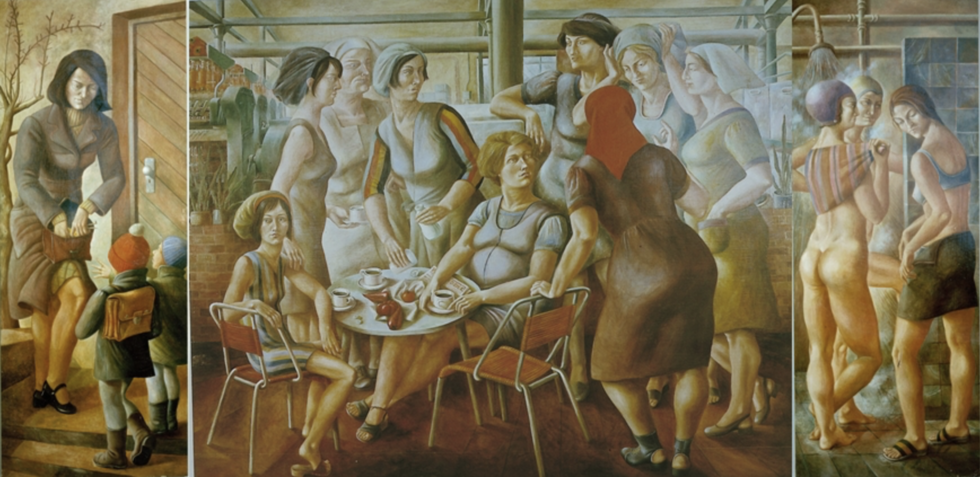
Petra Flemming: Women, panel painting, 1973–1974, Flemming estate, C. Flemming (CC-Sa 3.0)
From 13 September 2026, Open Monuments Day, the association baudenkmal bundesschule bernau will be hosting the exhibition ‘Women’s Work – Women’s Everyday Life – Women’s Rights’ by the German Trade Union Confederation (DGB) at its premises in the Teachers' house at Hannes-Meyer-Campus 9 in Bernau-Waldfrieden.
The exhibition will thus be on display at a venue whose own history is closely linked to the trade union movement: For over four decades, trade union work was carried out here and trade unionists were trained – initially at the FDGB’s ‘Theodor Leipart’ Trade Union School (1947–1951), and subsequently at the ‘Fritz Heckert’ Trade Union College (1952–1989). The exhibition thus forges a direct link between the site’s historical use and questions concerning women’s work, everyday life and rights won through trade union struggle – issues that remain relevant to this day.